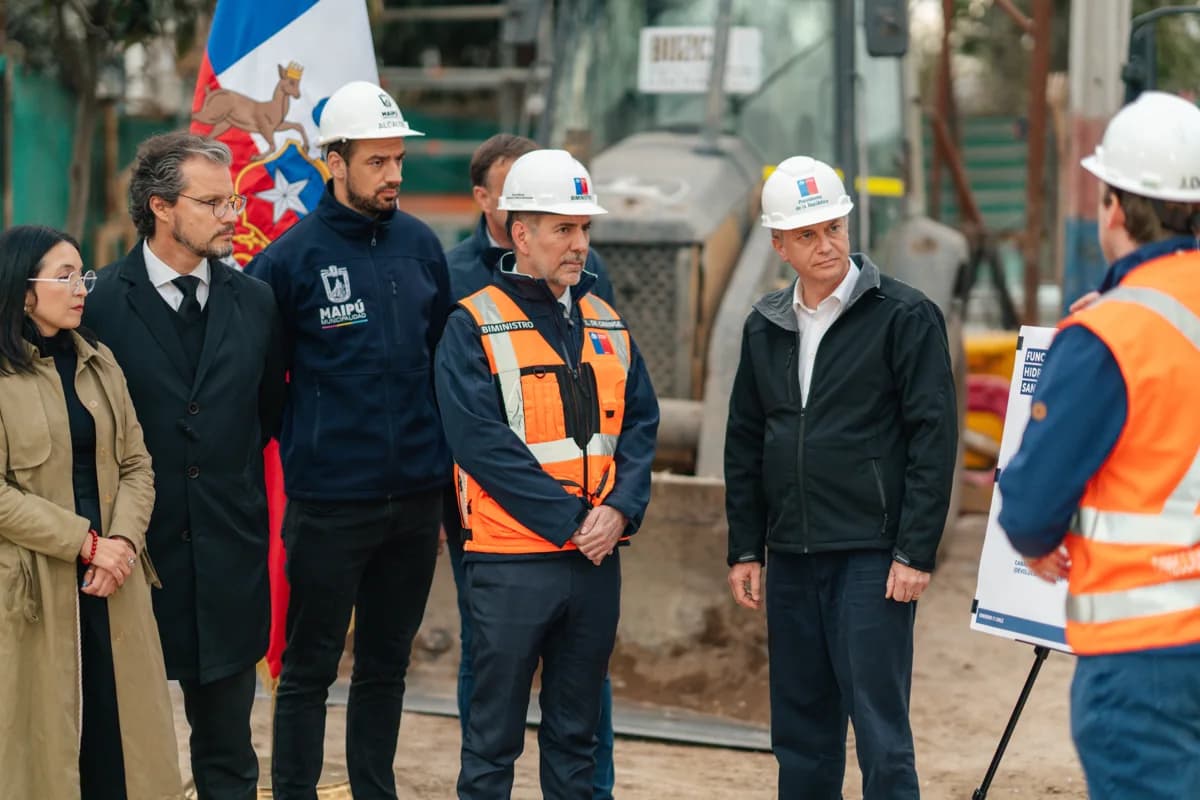
The Minister of the Interior instructed officials to explore ways to acquire and install weather radars in Chile, according to BioBioChile. Undersecretary of the Interior Máximo Pavez made the announcement this Friday, following the debris flow that hit San Carlos de Apoquindo in Las Condes.
Pavez acknowledged that this would be a very substantial investment and that "clearly" several units are needed across the country. The source does not provide an estimated cost.
That same day, Las Condes Mayor Catalina San Martin called on the state to act. "We need to invest in radars. Chile does not invest in radars and has never invested in radars," she said.
A weather radar emits electromagnetic waves that bounce off raindrops, snowflakes and other particles. Those signals identify where rain is falling, how intensely and in which direction the precipitation is moving. It can update its data approximately every five minutes, depending on its configuration.
Víctor Orellana, former national deputy director of the National Emergency Office (Onemi) and director of VOA Consultores, said these units would have improved real-time rainfall monitoring, especially in mountain areas that are difficult to observe.
Orellana explained that dual-polarization radars distinguish between types of precipitation and identify the layer where snow begins to melt. That information is crucial when the freezing level is high and rain falls where it usually snows, increasing the risk of surging river flows and mass movements.
The expert clarified that there is no fixed amount of advance warning. Depending on the phenomenon, coverage and river basin, useful information could arrive fifteen, thirty or sixty minutes in advance, or less. "Fifteen minutes can be decisive, but only if there is a system ready to act," he said.
He also warned that radar alone does not predict a debris flow. Issuing alerts requires ground sensors, river flow monitoring, hydrological models, danger thresholds and clear decision-making protocols.
Among the technical challenges, he mentioned that the mountain range can block signals, requiring careful study of installation sites. Other requirements include power, connectivity, maintenance, specialists and systems to process the data. According to Orellana, those obstacles require planning and sustained investment, but do not prevent installation.
The idea is not new. Arnaldo Zúñiga, a meteorologist with the Chilean Meteorological Directorate, said that following the 2019 tornadoes in the south, which left one person dead in Talcahuano, Sebastián Piñera's government commissioned a study.
That analysis identified eight locations in the country for installing C-band radars capable of detecting the amount of water in clouds and the presence of hail, as well as two mobile radars. According to Zúñiga, the initiative reportedly stalled following the social unrest and the pandemic.
So far, the government has not announced a timeline, funding amounts or the number of units it is considering acquiring.