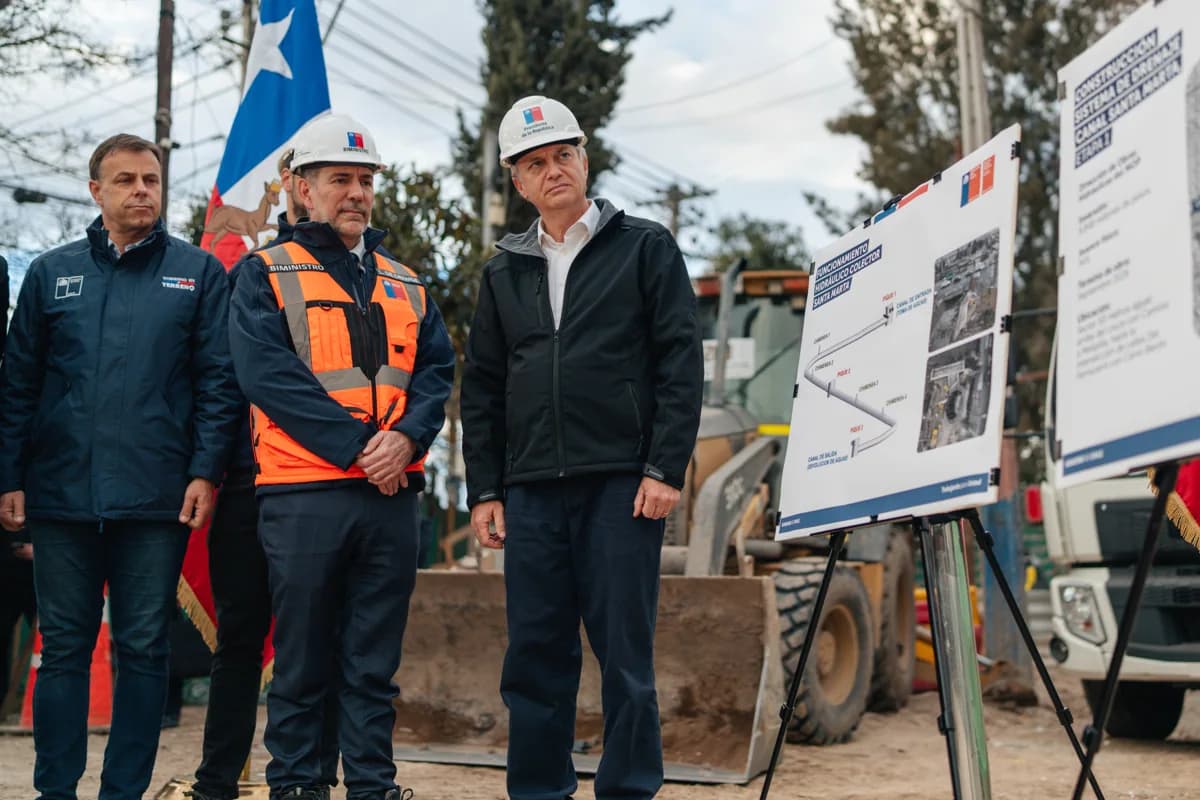
President José Antonio Kast has been monitoring from La Moneda the emergency that began with the mudslide on Thursday, October 8, in San Carlos de Apoquindo, Las Condes, and continued with Tuesday's rains in Santiago, according to La Tercera. The President did not visit the affected areas or take an active role in communicating the measures.
His stance contrasts with July. During the winter weather front that hit central-southern and northern Chile, Kast took a central role in the response. He toured affected areas and personally announced the government's measures.
According to the newspaper, the decision was deliberate. The President's team considered a visit to the affected areas, including health facilities damaged by the mudslide, alongside Ministry of Health officials. The prevailing view was that he should stay put until the emergency was under control.
The reasoning was operational. A presidential visit would have required assigning police officers to protect the President when teams needed to focus on the emergency. The scale was also a factor: the mudslide affected a limited area, although it left six people injured, swept away vehicles, overturned a public bus and flooded homes and health facilities. There were no deaths.
When the mudslide occurred, Kast had just returned from a tour of Biobío and Valdivia. He was meeting with Foreign Minister Francisco Pérez Mackenna when his team interrupted to inform him. Early Friday, he chaired an emergency meeting at La Moneda with some of his cabinet members.
Officials from the relevant ministries were deployed to the affected areas. Minister of Public Works and Transport Louis de Grange arrived in the area and flew over it. Undersecretary for Regional Development Sebastián Figueroa stayed in San Carlos de Apoquindo until late. Minister of Social Development María Jesús Wulf traveled to Talagante because of flooding at the Ribera del Río settlement, which required emergency shelters to be opened.
The top Interior Ministry officials were outside Santiago. Minister Claudio Alvarado was in Chiloé with Defense Minister Fernando Barros. Undersecretary Máximo Pavez had spent the day on Rapa Nui. Both had to return to the capital.
According to La Tercera, the criticism is not directed at the President's decision to remain at the palace. The government faces criticism over the lack of an Emergency Alert System (SAE) notification, the message sent to mobile phones, which could have enabled people to evacuate, for example, to higher ground. There are also claims that the response was faster because the affected area was in the wealthier eastern sector.
The latest issue concerns who speaks for the government. After Tuesday's rains, which brought hail and a tornado recorded in Santiago, coordination was put to the test again. No other source has so far confirmed the internal details reported by the newspaper.
This Wednesday, Ñuñoa Mayor Sebastián Sichel asked the government to designate an official spokesperson for emergencies. According to the mayor, without a clear structure, municipalities do not know whom to contact for information on decisions such as the suspension of classes.