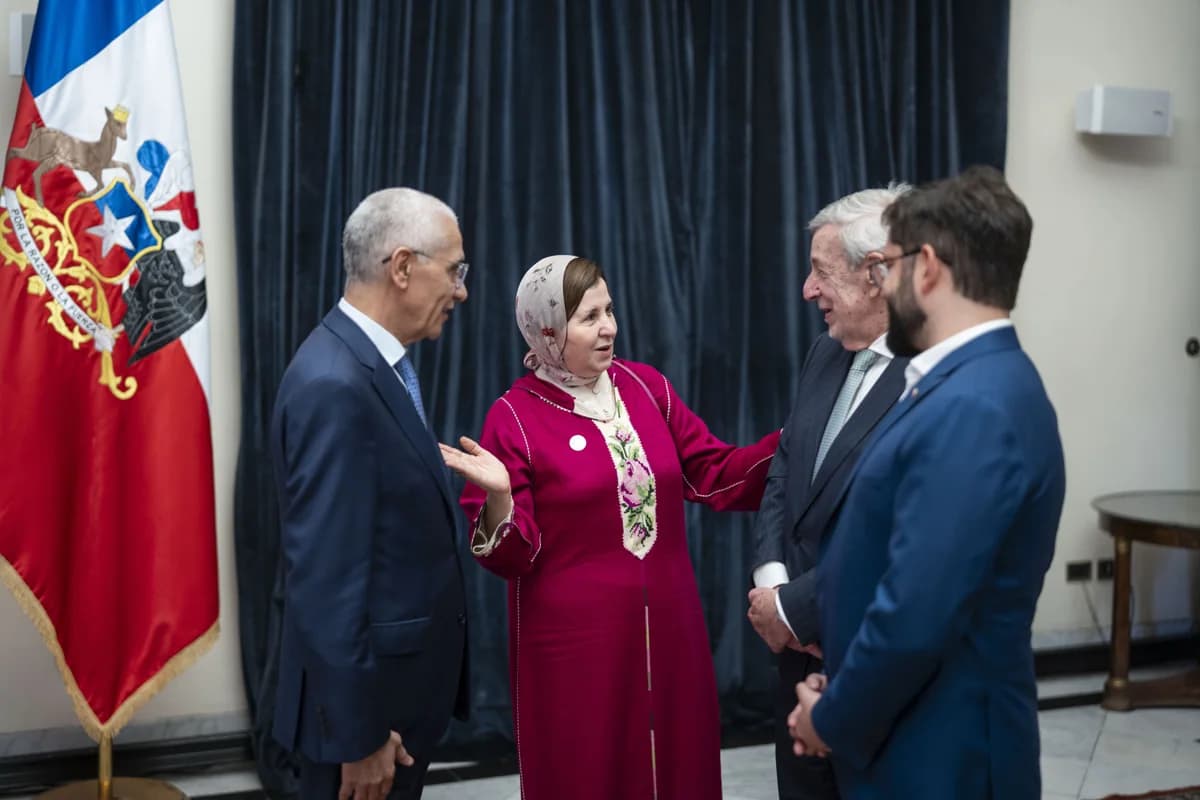
Foreign Minister Francisco Pérez Mackenna and Defense Minister Fernando Barros appeared on Wednesday before the full Senado (Chile's upper house of Congress). They explained the scope of Chile's joining of the Shield of the Americas, the mechanism promoted by U.S. President Donald Trump.
According to La Tercera, the special session was held at the request of senators from Socialismo Democrático. They complained about the absence of Security Minister Martín Arrau, who had also been summoned. According to the same outlet, Arrau was handling other matters of his portfolio in Congress.
President José Antonio Kast announced Chile's entry on September 22 in New York, according to El Periodista. The government made the decision without legislative approval. The mechanism aims to combat drug trafficking, transnational crime and terrorism.
Pérez Mackenna defended the measure on security grounds. "Transnational organized crime has already settled into the daily life of our country", he said. He added that the cooperation includes the exchange of information, technology and training for police officers and prosecutors.
The foreign minister insisted that the Shield is a political declaration and not a treaty, and is therefore not binding. He outlined three pillars. On security: intelligence sharing, training and coordination of financial sanctions against drug trafficking.
On the economic front, he mentioned evaluating investment screening mechanisms for security reasons, a reliable supply of critical minerals and rules for digital infrastructure providers. He stressed that those rules would be applied in a non-discriminatory way. The third pillar seeks to coordinate positions in multilateral forums.
According to the minister, the declaration identifies 24 criminal organizations. It proposes freezing their assets, imposing migration restrictions on them and prosecuting those who provide them with material support.
The opposition was not satisfied. Socialist senator Juan Luis Castro argued that the problem is what comes along with the police cooperation. He spoke of a political and economic alignment that did not go through Congress.
Castro also pointed to the invocation of the Inter-American Treaty of Reciprocal Assistance (TIAR), a collective defense pact. He warned that the clauses on critical minerals and digital infrastructure affect the relationship with China, Chile's main trading partner. In his view, Chile cannot apply sanctions to those 24 organizations without a law.
Communist senator Claudia Pascual questioned the fact that the Cancillería (Chile's Foreign Ministry) only communicated the anti-crime aspect. According to her, the text released by Washington places the economic objectives as the first pillar. She described the initiative as an extension of the United States National Security Strategy.
El Periodista reports broader criticism. Trump included control of ports and the flow of copper and lithium among the key issues. That outlet also describes a Joint Task Force under Southern Command, the U.S. military command for Latin America. That account was not addressed by the foreign minister, according to La Tercera's report.
Former presidents Michelle Bachelet and Gabriel Boric signed a joint statement. They acknowledged that cooperation against crime is indispensable, but without subordinating foreign policy to the priorities of a foreign power.
Senator Alfonso de Urresti (PS) announced the next step. The opposition will send a formal request for information (oficio) to Pérez Mackenna with each of the questions that, in their sector's view, remained unanswered.