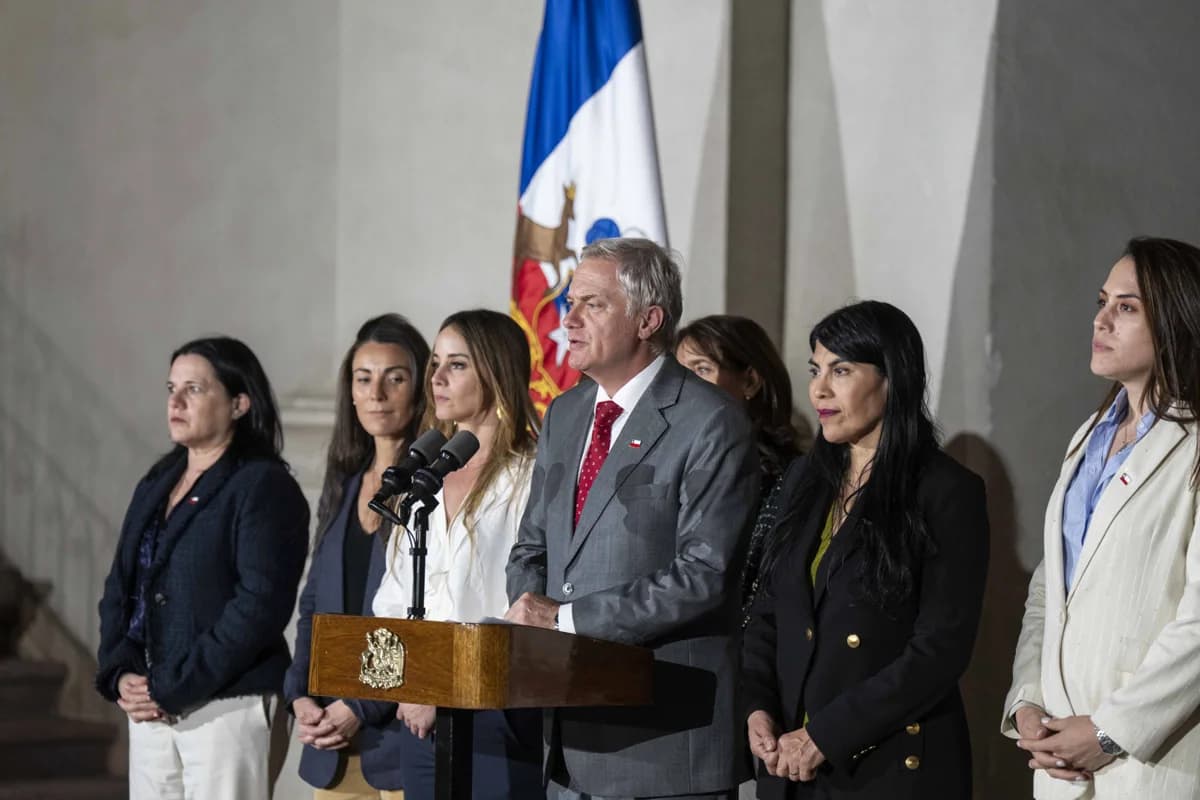

Minister of Science, Technology, Knowledge and Innovation (CTCI) Ximena Lincolao said the government is close to finalizing an agreement with OpenAI, the US company behind ChatGPT, according to Diario Financiero. She made the remarks on the outlet’s IA Lab program. She did not specify what the agreement would include or when it would be signed.
In the same conversation, Lincolao confirmed that Amazon Web Services (AWS) will open a data center in Chile in November. AWS is Amazon’s cloud division. A data center is a building with servers that store information and process digital services.
The minister also announced that she will meet with Jensen Huang on November 11, the CEO of Nvidia, the US company that makes most of the chips used to train artificial intelligence (AI). She said she would raise the possibility of the company establishing a presence in the country "in a more pragmatic way." Nvidia has made no commitment so far.
Lincolao added that a "nontraditional" data center that uses natural energy sources will be announced in December. She did not disclose which company is behind it or where it would be located.
The minister said Chile has advantages that help it compete: low-cost renewable energy, connectivity and access to data, such as data from the Vera Rubin Observatory, which opens in December. "Chile has the capacity, but it has to complete that cycle," she said, referring to the chain running from energy generation to access to AI tokens (the units used to measure and charge for the use of these systems).
She also acknowledged limitations. She said Chile’s regional leadership in AI "has stalled," computing capacity is scarce and few companies use the technology. In her ministry alone, they found more than 50 programs without an API (an interface that allows systems to connect to one another) or cybersecurity standards. "You cannot put AI on top of infrastructure that does not work," she said.
For people working or studying, the most concrete announcement is a competition for tokens for startups and researchers that will launch in November, with packages from Microsoft, Google, AWS and OpenAI. ElevenLabs, a synthetic voice company, will provide access to 100 Chilean companies, and Google will give Gemini licenses to students at universities, professional institutes and technical training centers. The rules and exact dates are not yet known.
The ministry also created a Department of the Future of Work, focused on technical education, short training courses and certifications. "We are hiring a director," Lincolao said.
Following a tour of Silicon Valley and Washington with Foreign Minister Francisco Pérez Mackenna, Chile signed the Kyoto Vision for a Golden Age of Science alongside 16 other countries.
For 2027, the minister projected more Chilean software supplied to the state, greater flexibility in ChileCompra to contract local startups and a public-private effort to test chip manufacturing in the regions. "Perhaps we will lose a little at first, but eventually we will win," she said.